Why Defence Is Dual-Use for Caseway, Not a Pivot

Al Vigier
Published: 6/3/2026
When a company built on legal AI starts talking about cyber situational awareness and counter-drone decision support, the natural assumption is that it has changed course.
That assumption is wrong. Caseway has not set aside legal technology to chase defence budgets. The defence work and the legal work run on the same engine, aimed at the same kind of problem from two directions.
The Model Palantir Proved
It helps to look at the company that proved this model works. Palantir was incorporated in 2003 by Peter Thiel, Alex Karp, and a small founding group, with roughly two million dollars of early funding from In-Q-Tel, the CIA's venture arm.
Its first customers were intelligence and defence agencies trying to make sense of fragmented data in the years after 9/11. Only later did Palantir carry that same software into banking, manufacturing, healthcare, and energy. One foundation, many industries.
The company now trades at well over 300 billion dollars. The lesson was never about a single sector. It was about owning the layer where scattered data becomes a decision you can defend.
The Same Play, Run in Reverse
Caseway runs the same play, in reverse. We started in law, which is the most document-heavy, precedent-bound, high-consequence decision environment in the commercial world. Defence came second, built on the foundation we had already proven.
One Engine: Synthium
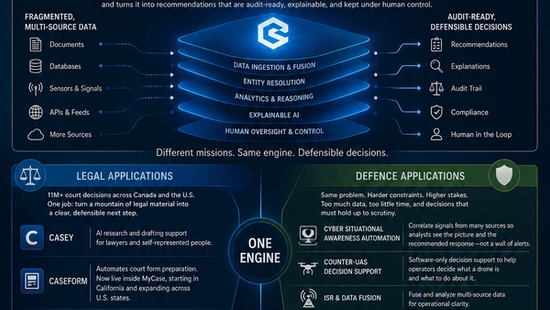
That foundation is Synthium, our decision and data layer. It sits above fragmented, multi-source information and turns it into recommendations that are audit-ready, explainable, and kept under human control. That last point matters. In a courtroom and in a security operations centre alike, a recommendation that cannot be traced and justified is worthless.
What It Looks Like in Law
On the legal side, that engine powers a corpus of roughly 11 million court decisions across Canada and the United States. Casey turns that corpus into research and drafting support for lawyers and self-represented people. CaseForm automates court form preparation and is now live inside MyCase, starting in California and expanding across US states.
CaseLite makes legal information searchable for the public. Different products, one common job: take a mountain of unstructured legal material and produce a clear, defensible next step.
What It Looks Like in Defence
The defence work asks for exactly the same thing, under harder constraints. Our primary focus is cyber situational awareness automation, correlating signals from many sources so that an analyst sees the picture and the recommended response rather than a wall of alerts.
Our second line is counter-UAS decision support, software only, that helps an operator decide what a drone is and what to do about it.
Beyond that sit ISR and data fusion, northern infrastructure analytics, and space domain awareness. Every one of these is the legal problem wearing a uniform... Too much data, too little time, and a decision that has to hold up to scrutiny afterward.
Dual-Use, Not a Pivot
This is why dual-use is the honest description and a pivot is not. A pivot means abandoning one thing for another. We are doing the opposite, taking a decision engine that already works on the hardest commercial problem we could find and applying it where the consequences are higher and the data is messier.
The legal business funds and sharpens the technology. The defence business proves it in the most demanding conditions that exist.
Why It Matters for Canada
There is a national argument here too. Canada's instinct in defence is to buy hardware, usually from somewhere else. The capability that actually decides outcomes now lives in the software layer that fuses sensors, weighs options, and recommends action. That layer can be sovereign and Canadian.
Early in the Same Story
Palantir spent more than twenty years proving that one decision platform can serve radically different industries. Caseway is early in that same story. We just happened to start in the courtroom.
See how organizations use Caseway to automate high-stakes workflows.
View Success Stories