Year two at Web Summit Vancouver: what we want this time

Al Vigier
Published: 5/9/2026
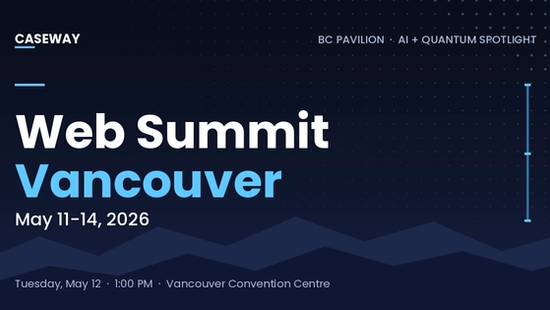
Web Summit Vancouver runs May 11 to 14 at the Vancouver Convention Centre. Caseway will be there for the second year in a row, this time as one of twelve BC ventures selected for the AI + Quantum block of the BC Venture Spotlight at the BC Pavilion, presented by Innovate BC in partnership with AI in BC and the Quantum Algorithms Institute.
Our slot is Tuesday afternoon, May 12.
Last year was a re-introduction. This year is different, and worth explaining why.
Last year, we were the lawsuit company
In May 2025 we walked into Web Summit Vancouver fresh off a court fight with a national case law database that had sued us for using publicly available court decisions.
They didn't get their injunction. We didn't do anything wrong. But it sucked momentum out of the year, and we used the conference to take the narrative back. I wrote about that approach for Vancouver Tech Journal: How we made Web Summit work for us, instead of just surviving it.
The CanLII matter settled confidentially in March 2026. That chapter is closed. The story we're telling at Web Summit this year has nothing to do with it.
What changed in twelve months
A short list of what's different about Caseway since we last set up at the Convention Centre.
Caseway is now positioned as a Vancouver automation company that partners with large enterprises through a joint venture model and shares revenue with them. That's the partnerships page.
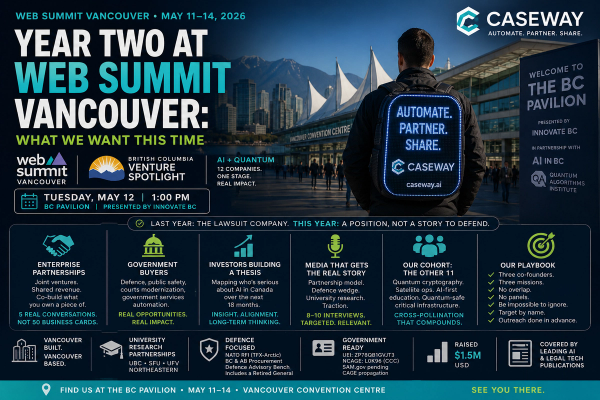
The product line has settled into three lanes: Casey for legal research and drafting, CaseForm for legal form workflow automation (live with our 8am / AffiniPay integration), and Synthium for enterprise.
We've been registering for government work in earnest. Federal procurement IDs are in place (UEI ZP78QB1GVJT3, NCAGE L0K96 via the Canadian Commercial Corporation), with SAM.gov pending CAGE database propagation.
We submitted a response to NATO ACT's RFI on Innovation Continuum 2026, the TFX-Arctic challenge. We're registered in the BC Defence Supplier Directory and tracking active Alberta procurement opportunities. There's a defence page for that work.
We have research partnerships with UBC (Dr. Vered Shwartz), SFU (Dr. Angel Chang), Northeastern, and the University of the Fraser Valley.
We have a defence advisory bench that includes a retired General. We raised $1.5M USD. Half a dozen Canadian and US legal AI publications now cover us as a normal market participant rather than a curiosity.
In other words: this year we walk in with a position, not a story to defend.
Why the AI + Quantum Spotlight matters to us
Innovate BC's selection process picks twelve companies in this category. Being chosen is a signal in two directions. To buyers and investors, it says BC's economic development arm vetted us as investment-ready.
To us, it says the work is landing where it needs to land. Techcouver covered the lineup when the cohort was announced.
There's a more practical reason this category is the right one. Federal, provincial, and allied government dollars are flowing toward AI and quantum together. Defence is increasingly treating them as one stack. Sitting in this block, on a programmed Tuesday afternoon, is the right room for the conversations we want to have.
What we actually want out of these four days
I'll be specific because most founders aren't.
Enterprise partnership conversations. The joint venture model is how we scale. We need to talk to the operators inside large companies who are tired of buying AI tools that don't move their numbers, and who would rather co-build something they own a piece of. Five real conversations is the bar. Not fifty business cards.
Federal and provincial buyers. Procurement is a slow grind, and conferences are where it accelerates. Anyone connected to defence procurement, public safety, courts modernization, or government services automation, that's the conversation we want. NATO RFI work, Alberta Courts AMS, Forfeited Asset Management, BC defence stack: all live, all relevant.
Investors who are building a thesis around AI in Canada. Not pitching for a round. Mapping who's serious about the next eighteen months.
Media that reflects the current Caseway. Eight to ten interviews would be the goal, with reporters covering enterprise AI, government technology, and Canadian innovation policy. The story is the partnership model, the defence wedge, the university research, and the traction. Not the lawsuit.
The other eleven companies in our cohort. Some of them are doing things we should know about. Quantum cryptography, satellite operations, AI-first education, quantum-safe critical infrastructure. The cross-pollination from a curated cohort is underrated.
How we're running the four days
The playbook from last year still works. Three co-founders, three different missions, no overlap. Skip the panels. We didn't fly in to sit in an audience. Be impossible to ignore on the floor (we're bringing the LED backpacks again, with a refreshed message). Target the people we already identified, by name, before getting on the plane.
One change from last year: more outreach in advance. Last year I figured out who I wanted to meet once I was already on-site, which is too late. This year the list is built, the emails are sent, and the calendar is half full before we walk in.
Why we're still doing this from Vancouver
Web Summit chose Vancouver. Innovate BC built a real pavilion around it. Twelve AI and quantum companies are showing because the ecosystem is finally getting credit for what it's been quietly building for a decade.
Caseway is built here, our team is here, our research partners are here, and our home advisory work is here. Showing up at the home conference, in our home category, on our home turf, is not a marketing exercise.
It's the through-line.
If you're in town for the week and any of the above lines up with what you do, find us at the BC Pavilion on Tuesday. Or come say hi at the booth any day from May 11 to 14. The backpacks are hard to miss, and we might have a robot dog this year as well.
See how organizations use Caseway to automate high-stakes workflows.
View Success Stories