Why Court Forms Are So Hard, and What That Costs the People Filling Them Out

Al Vigier
Published: 8/21/2026
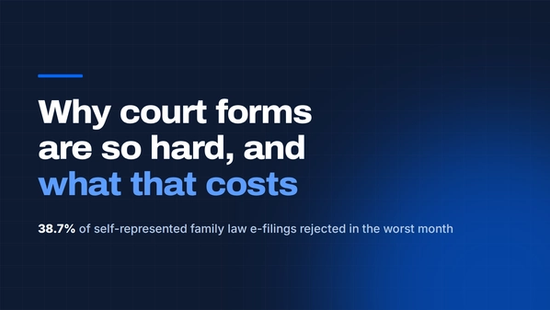
Every month, the Superior Court of California, County of Los Angeles publishes a report on how often electronic filings are rejected. In the year from December 2022 to November 2023, filings submitted through the court's self-represented "Guide & File" channel for family law were rejected at monthly rates as high as 38.7 percent, well above the roughly 17.5 percent court-wide family-law average and the 9.0 percent average for civil filings overall (Superior Court of California, County of Los Angeles EFSP Rejection Rates report).
The court also lists why filings bounce. The reasons are procedural: an incorrect filing code, a case number that does not match, a document missing information or attachments, the wrong court location, a form that is out of date (LA Superior Court). LA Court
None of those rejections turns on the merits of anyone's case. They turn on the paperwork. And the people most likely to get the paperwork wrong are the people filling it out without a lawyer.
Who is filling out these forms
The share of court users without lawyers is now the norm in large parts of the civil system, not the exception. The National Center for State Courts, in its landmark study The Landscape of Civil Litigation in State Courts, found that at least one party was self-represented in more than three-quarters of the roughly 925,000 cases it examined (State Justice Institute summary). The Self-Represented Litigation Network estimates that eighty percent of people in civil cases go to court without a lawyer (SRLN).
The reason is cost. The Legal Services Corporation's 2022 Justice Gap study found that low-income Americans received no or inadequate legal help for 92 percent of their civil legal problems, and that 74 percent of low-income households experienced at least one civil legal problem in the previous year (LSC Justice Gap, Executive Summary).
Stanford Law researchers, cited by the American Bar Association, put it at roughly 15 million cases each year in which at least one American faces court without representation (ABA).
Canada looks similar. The National Self-Represented Litigants Project, founded by Julie Macfarlane at the University of Windsor, was built on interviews with 259 self-represented litigants across Ontario, British Columbia and Alberta (NSRLP final report via SRLN).
NSRLP's executive director, Jennifer Leitch, has told CBC that roughly 50 percent of all civil cases in Canada now involve a self-represented party, and that a week-long trial can cost between $50,000 and $80,000 (CBC News).
The forms are written above the reading level of the people using them
Set the caseload next to what is known about adult literacy. In the 2023 round of the international PIAAC survey, 28 percent of United States adults, about 58.9 million people, scored at or below Level 1 in literacy, meaning they struggle with multi-step instructions and complex text (ProLiteracy; NCES PIAAC). In Canada, 19 percent of adults scored at Level 1 or below (Statistics Canada).
Court documents are routinely written well above that. When Canadian researchers Amy Salyzyn and Jacquelyn Burkell studied what makes court forms hard, they used a functional literacy framework and found unclear grammar, unexplained technical terms, vague guidance and wide variation in reading level across forms (Salyzyn et al., Literacy Requirements of Court Documents, Windsor Yearbook of Access to Justice). Macfarlane's team found court guides written as high as a 13.5 grade reading level (NSRLP via SRLN).
A separate cross-sectional study of state-sponsored advance directive forms found an average reading level of grade 11.9, with no form at or below the fifth-grade level (study in PMC).
The effect on comprehension is measurable. In a comparative readability study run for California's courts by the language firm Transcend, applying plain-language principles to one form raised the share of readers who understood its purpose from 23 percent to 70 percent, and on another form the share who could correctly say how to use it rose from 60 percent to 90 percent (Center for Plain Language).
Court staff feel it too. In a national survey prepared for the Association of Canadian Court Administrators, 97 percent of court staff agreed that self-represented litigants needed help completing court forms (Salyzyn et al., What Makes Court Forms Complex?).
Why the forms are like this
It would be easy to blame the people who run the courts. That would be wrong. Court forms are the way they are for structural reasons that have nothing to do with the diligence of clerks or judges.
Forms accrete. A field gets added because a statute was amended, another because an appellate decision required a specific disclosure, another because a rule of civil procedure demands a particular certification. Over decades, each addition is individually justified and the sum becomes dense. Most courts have no design budget and no mandate to simplify.
The people who administer them are absorbing a caseload that is now majority self-represented while also being the front line that self-represented filers turn to for help. Court administrators have documented the problem themselves and have been pushing plain-language work for years, including the National Center for State Courts' form-simplification resources and readability guidelines adopted by trial courts such as the Massachusetts Trial Court (Mass.gov).
There is also a legal-drafting reason plain language is not simply mandated everywhere. The federal Plain Writing Act of 2010 requires federal executive agencies to write clear communications the public can understand (Digital.gov). It binds those agencies. It does not bind the courts, which are a separate branch, so court forms sit outside its reach.
The same problem, a different form in every jurisdiction
A person who moves, or whose case crosses a border, meets a second layer of difficulty. The same legal action can require different forms, different vocabulary and different steps depending on where it is filed.
Consider divorce. In California, approximately 200,000 divorce petitions are filed each year, with at least one self-represented litigant in 70 percent of cases at the start, rising to 80 percent by the time of judgment. Utah reports 49 percent of petitioners and 81 percent of respondents self-represented, and New Hampshire reports nearly 70 percent of domestic-relations superior court cases with at least one self-represented party (California Law Review).
Each of those jurisdictions has its own packet, its own filing fees, its own service rules and its own words for the same concepts. Filing fees to start a case alone range from $50 to $450 depending on location (CustodyXchange). There is no shared national vocabulary to carry a litigant from one system to the next.
Language adds another axis. The Department of Justice recommends that recipients of federal funding provide written translations of vital documents for each limited-English-proficiency group that makes up five percent or 1,000 people of the population served, whichever is less (Consortium for Language Access in the Courts, via NCSC). Whether a given court form actually exists in a litigant's language varies widely from place to place.
The cost lands as time, delay and abandoned claims
The cost of all this is not abstract. Salyzyn and Burkell note that form complexity can lead to mistakes, and in some cases can be so demoralizing that a person chooses not to pursue or defend a claim at all. In one study, more than half of Ontario family law litigants reported difficulty with court forms and understanding their legal rights (Manitoba Access to Justice Hub summary).
Delay compounds it. The Advocates' Society, a national Canadian lawyers' organization, reported that in the worst-affected courts a litigant can wait up to five years for a civil action to reach trial in Ontario, and an average of 593 days between filing and trial for small claims under $15,000 in Quebec (CBC News). A rejected filing does not just cost the hour it took to complete. It can cost another trip, another wait and, sometimes, a missed deadline.
What actually helps
The evidence points to a short list of things that work, none of which requires blaming the people who run the courts.
Plain-language redesign is the most proven. The Transcend results show that comprehension roughly triples on some forms when the language is fixed. Standardising the vocabulary of common fields across jurisdictions would let a litigant, and any software helping them, carry information from one system to the next.
Guided interviews and form automation, which ask a person plain questions and assemble the correct form from the answers, reduce the number of ways a filing can go wrong. And courts that publish their rejection data, as Los Angeles does, create the feedback loop needed to find and fix the fields where filings actually fail.
This is the part of the problem Caseway works on. Its court-form product, CaseForm, is available inside the practice-management platform MyCase through 8am, whose platform serves more than 250,000 professionals (LawSites; CPA Practice Advisor).
It pulls existing case data into thousands of court and government forms and validates entries against jurisdiction-specific rules in real time to reduce rejections (Caseway; Alabama State Bar). Caseway also runs a free case-search product, CaseLite, for the US and Canada.
What software cannot fix
Automation addresses the mechanics of a form. It does not decide whether a claim is worth bringing, and it does not replace legal advice. If a form asks the wrong questions, filling it out faster produces a completed version of the wrong form. If the underlying law is unjust or a fee is unaffordable, no interface changes that.
And a tool that pre-fills fields can carry an error forward as easily as a correct answer, which is why validation and human review matter. Software can lower the barrier that complexity creates. The barriers that come from underfunded courts, from the absence of a right to civil counsel, and from law written for lawyers are the work of legislatures, courts and the bar.
Caseway's own recent writing has argued a similar point about keeping the human decision layer central, in its legal work and across its other lines of business.
The forms are hard for understandable reasons. Fixing them is a design problem and a funding problem, and both are solvable.
Al Vigier is the founder and CEO of Caseway, a Vancouver-based AI company. He served seven years in the Canadian Army.
See how organizations use Caseway to automate high-stakes workflows.
View Success Stories